


Je n’ai pas encore eu le temps de l’acheter pour Manon, mais voilà un petit livre dont parle Thomas Clément, dont sans aucune honte, je reprends une partie du post (c’est grave?).

Le concept c’est de se demander pourquoi certaines choses ou certains concepts ont été inventés.

L’auteur de ce petit livre c’est Pierre Dominique Burgaud ( son myspace).
 I hadn’t heard of Amazon Mechanical Turk before today and it’s use to try to find Steve Fossett.
Amazon’s definition is « we build complex software applications based on the things computers do well, such as storing and retrieving large amounts of information or rapidly performing calculations. However, humans still significantly outperform the most powerful computers at completing such simple tasks as identifying objects in photographs—something children can do even before they learn to speak.
When we think of interfaces between human beings and computers, we usually assume that the human being is the one requesting that a task be completed, and the computer is completing the task and providing the results. What if this process were reversed and a computer program could ask a human being to perform a task and return the results? What if it could coordinate many human beings to perform a task? »
But the fun stuff is where the name comes from « In 1769, Hungarian nobleman Wolfgang von Kempelen astonished Europe by building a mechanical chess-playing automaton that defeated nearly every opponent it faced. A life-sized wooden mannequin, adorned with a fur-trimmed robe and a turban, Kempelen’s « Turk » was seated behind a cabinet and toured Europe confounding such brilliant challengers as Benjamin Franklin and Napoleon Bonaparte. To persuade skeptical audiences, Kempelen would slide open the cabinet’s doors to reveal the intricate set of gears, cogs and springs that powered his invention. He convinced them that he had built a machine that made decisions using artificial intelligence. What they did not know was the secret behind the Mechanical Turk: a human chess master cleverly concealed inside. »
Turk was launched in 2005 with much hype (well not so much as I didn’t hear about it) but it seems that the system didn’t live his hype up. Nonetheless, for a few days now, one of the HIT (Human Intelligent Task) has been set up to Help Find Steve Fosset.
How does it work?
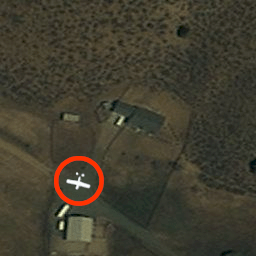
You will be shown a single satellite image. The task is to flag any satellite images which contain foreign objects that may resemble Steve’s airplane or parts of a plane. Steve’s plane will show up as a regular object with sharp edges, white or nearly white, about 21 pixels long and 30 pixels in wingspan.
Marked images will be sent to a team of specialists who will determine if they contain information on the whereabouts of Steve Fossett.
Sample Imagery
 |
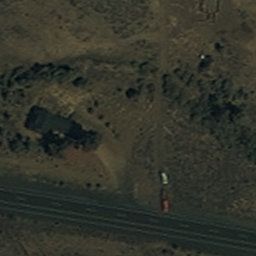 |
| Example of the size of object to look for. The white plane shown above (30 pixel wingspan by 21 pixels by length) is approximately the size of Steve’s plane. | Example of two cars next to a highway/road. |
You can also check the area on GoogleEarth (38.430862,-119.442673), but first, you have to get Steve Fossett KML file.
An old satirical video re-posted recently on E-conomy (Aziz Haddad’s blog). I had never seen it, it’s quite funny. I’ll end the post by the same sentence as Aziz « I look forward sleeping with you » 🙂
Grâce à Pierre, je suis passé sur la Google Library ce soir. Je n’avais jamais regardé à quoi cela ressemblait. Impressionnant.
Une page de recherche simple à la Google, une page de recherche avancée (ISBN, auteur, editeur) et surtout contenu! Des parties assez importantes de livres sont en ligne pour le moment. J’étais particulièrement étonné de voir des bouquins de business assez récent directement disponible. Visiblement, Google pourrait prochainement rendre l’accès payant. Moi je préférerais qu’ils laissent l’accès libre, avec le contenu complet ne ligne, mais qu’ils mettent des liens sponsorisés dans le texte des livres avec versement d’une partie des revenus aux éditeurs, non?
Bref, en un click, vous pouvez vous créer votre bibliothèque virtuelle. Et vous pouvez également la créer en important une liste de numéro ISBN. Sympa.
Google rules
Voilà un post que j’aurai dû faire il y a quelques temps déjà. Un sujet que j’apprécie, un mélande de musique, de vidéo, de techno et de buzz. Tout ce que j’aime. Vous connaissez le groupe Gorillaz, un groupe de musique virtuel dont les 2 créateurs principaux sont Damon Albarn (le chanteur de Blur) et Jamie Hewlett (le dessinateur de Tank Girl).
Comment un groupe virtuel qui n’existe qu’en dessin-animé se produit sur scène? C’est une question que les spectateurs de MTV se sont posés en 2005, lors de la cérémonie des MTV Movie Awards. La scène se libère, et … première performance live sur scène avec des hologrammes 3D, basé sur la technologie de Musion Eyeliner 3D.
Franchement, c’est frime … jetez un oeil là-dessus:
En 2006, plus fort, Gorillaz live avec Madonna, au Grammy Awards.
Et à venir, on entend parler d’un world tour, la première tournée d’un groupe virtuel.
Si vous voulez en savoir plus sur la techno, on peut trouver quelques infos sur le site de Dimensional Studios.
« Breast Reduction Surgery? That’s like slapping God across the face. »
Jonah « Seth » Hill in Superbad.
La comédie de l’été aux US, produite par Judd Apatow je vous en reparle prochainement

 The R Blog